
Blogs
Chatham House Speech - Ashok Gupta
This is a transcript of a speech given by New Capital Consensus Director, Ashok Gupta, at a panel event at Chatham House on the 18th June 2026.
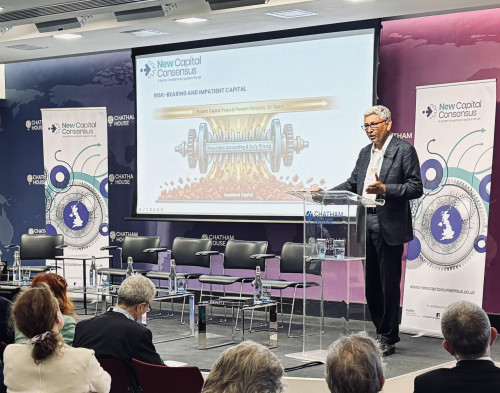
Hello, and welcome.
Nearly all developed countries struggle to attract the investment capital needed to boost productivity and renew infrastructure. The UK is different. We don’t have a shortage of capital. The money exists: 2ND SLIDE £6 trillion - predominantly our retirement funds - the second-largest pool of investment capital in the entire OECD.
Yet, we have low relative levels of investment. And when we look at who is funding our infrastructure, from energy networks to housing, — too often it is not us. It’s Dutch and Canadian asset owners. They are investing patiently in British physical assets. The question is why our own institutions are not.
That is the conundrum New Capital Consensus was established to address. Today, I want to walk you through what we've found, why it matters, and what needs to change.
The £6 Trillion Investment Engine
Let me remind you how the UK investment system functions – I don’t say ‘how it works’ because really it doesn’t.
Real investment is made by companies on the right using money from savers on the left. And in between CLICK we have all the agents who intermediate between companies and savers.
This system is crucial to the successful operation of all our infrastructure: energy, transport, health, defense, schools. The way we finance these physical systems affects their impact on the environment.
But the profit-making gravitational pull of the investment system is huge and corrupting. We have financialised the water industry. We have converted houses into trading assets. We have put short term liquidity and risk management ahead of sustainability and long-term individual and societal outcomes.
This happens because of the way our investment system is intermediated. CLICK Asset owners are the weak link and unless we fix this it will threaten the sustainability of our businesses and our economy.
We have also failed to contain climate change to 1.5 degrees. We are going to have to adapt to new climate realities: build resilience to drought, to flooding, to water shortages and sea level rises, and to extreme temperatures and their impact on our health, our housing and our way of life.
To ensure our cities are resilient, to build new infrastructure and to support food, energy and water security, we need to invest in sustainability at scale. We will also need a new relationship between savers, government, and regulators.
The routing problem
The challenge is not that we don’t have enough money but how it flows through the investment system
Think of investment flow like the water system. There is no shortage of water. But between the reservoir and the taps, the pipes are leaking, blocked, or simply pumping water to the wrong places.
For example, much of our money CLICK is used to fund gilt purchases for the UK government. And a lot CLICK is invested in large global companies at the expense of our own businesses and innovators.
Very little, CLICK less than 5%, goes into UK infrastructure, housing and regional firms.
Inherited Frictions in a Complex System
So what’s gone wrong? Our research points to four structural problems that have developed over decades, often as unintended consequences of well-intentioned regulation.
The first is a focus not on returns but on risk reduction. We incentive reducing risk and cost over returns – this comes at a price. The regulatory response to the GFC has left many institutional investors in a lingering defensive posture — prioritizing capital preservation over return-seeking. That made sense in 2009. It does not make sense in 2026.
The second is fragmentation. This leads to low-quality asset allocation. There are still around 5,000 distinct Defined Benefit private pension schemes in the UK. That may sound like diversification. In practice, they act as a herd, amplifying risk not diversifying it.
Scale matters. Without sufficient scale, you cannot afford the investment skills needed to identify and access the kind of long-term, illiquid investments that build real things. With too great scale, you don’t have the appetite to make smaller regional investments. We need to hit the Goldilocks spot for investment: neither too big or too small.
The third friction is overseas flow. DC and unit-linked investment capital direct money disproportionately into US technology companies. This is not deliberate: just what happens when everyone follows global market-cap indices
But indexing comes at a significant domestic cost. It means we give our much-needed investment funds to the Mag7 so they in turn can buy British fledgling tech businesses. We are literally paying the Americans to take away our future innovators and rockstar companies.
And the fourth friction is secondary market bias. There is a persistent preference for secondary market trading over primary investment. Secondary markets are important, but they do not build real things. They do not build capacity. Oversized and dominant secondary markets are a structural drag on productive investment.
Here is the good news: The Government is Moving — and in the Right Direction
Policymakers have identified at least some of these bottlenecks, and recent interventions are well-targeted.
The Value for Money framework is designed to shift DC trustees away from cost minimization, toward a genuine assessment of long-term returns. That is the right instinct. Cheap is not the same as good value.
But this is not enough. The current focus on backward looking measures is unhelpful. Instead, our proposed Effectivity Screen would be forward-looking, and controlled by the Government rather than regulators.
The Pension Schemes Act directly attacks fragmentation through consolidation.
Fewer better-capitalised funds can access opportunities not available to smaller schemes. We support this rationalisation but we worry it’s half-hearted. The way Superfund regulations are constructed is key. The Government has the ability to create our own Maple 8. There’s no sign yet that it has the political ambition to do so.
The Mansion House Accords and the Sterling 20 initiative attempt to address overseas flow — redirecting some capital towards domestic opportunities and real-world asset creation. But these steps are not enough to incentivise investment in UK growth businesses. Tax incentives or disincentives will be needed. We will be publishing a paper on this shortly.
The right steps in the right direction but we need to go much further and far faster.
But There Is One Step Remaining — And It Is the Most Important
Because even if we perfect consolidation, perfect value frameworks, and perfect domestic allocation targets — there remains one final friction that undermines all our investment.
It is our attitude to risk.
Specifically: the way our regulatory and accounting systems define, measure and penalize long-term risk.
Pension savings are long-term by their very nature. A 30-year-old has at least a 30-year investment horizon. That is patient capital - that can tolerate short-term volatility in exchange for long-term returns. It is exactly the kind of capital that infrastructure projects need: long development cycles, illiquid characteristics, but strong long-run fundamentals.
But our regulatory and accounting frameworks takes that naturally patient capital and - through the blades of daily pricing and short-term market-based risk management - transforms it into impatient capital. It shreds a 30-year horizon into 11,000 one-day horizons.
In doing so, they disadvantage exactly those investment opportunities that patient investors should be capturing. Our investment system is only fit to dig 11,000 separate holes, not to build a new reservoir. Maybe that’s why the last new English reservoir opened 35 years ago.
We are not arguing for more risk. We are arguing for better risk management — specifically, for a regulatory framework that distinguishes between short-term and long-term risk, and reintroduces genuine risk diversity back into the system. An investor who can hold an asset for 20 years has a fundamentally different risk profile from one who may need to liquidate tomorrow. Our system treats them the same. That is wrong, and it has serious consequences for our economy.
The question we keep returning to is this: why are Dutch and Canadian asset owners able to invest in UK infrastructure more effectively than our own domestic institutions? The answer is not that they are smarter, or that they have more money. It is because their systems recognise the value of long-term, patient capital — aligning liability horizons with physical asset lifecycles. We can and must do the same.
The New Capital Consensus
Let me close with a vision.
Coupling bolder action on VFM, Superfund consolidation, and incentivising UK investment, with a modernised, long-term approach to risk can unlock the full potential of that £6 trillion.
The destination is clear: a system where British savers' money funds our physical systems, drives UK productivity and builds resilience to climate change. Where our money can also support emerging markets better, instead of the Mag7
This is not a utopian vision. It is a practical, achievable system fix. The money is already there. The policy direction is broadly correct. What remains is the intellectual and political courage to recognise that pension funds and life insurers are investment institutions, not traders. We need to design a system that reflects that truth.
New Capital Consensus exists to build this consensus. Across government, regulators, asset owners and fund managers. Because the decisions made in the next few years will shape both retirement outcomes and the UK's economic trajectory for a generation.
The pipes exist. The resources are there. We just need to point them in the right direction and let the money flow.
Thank you.




Please login or register to leave a comment on this post.