
Blogs
October 2026 NCC Newsletter - Tilting the Playing Field
From the Director
After a spirited and broadly encouraging Labour Party conference, I am left with the feeling that this government genuinely grasps the need to rewire the investment system to boost domestic growth. They are, however, in danger of missing an open goal by ignoring the relationship between insurers and consolidated pensions vehicles.
'Growth in every postcode' is the rallying cry of the new Burnham administration, and it is one we echo at NCC. We need to redesign the system so that savers' money is being used to improve the areas in which they will retire. But what is still lacking is the mechanisms to deliver that capital into those areas - connecting capital with projects that require it to scale, grow businesses and improve the economies of left-behind areas of the country.
The good news for the government, HMT, DWP and the Department for Business, Innovation and Trade is that we can unlock £1 trillion of productive investment over the next ten years without spending any new money. We just need to make changes to a system that destroys patient capital or exports too much of it to wealthier markets than the UK (particularly the USA).
One immediate move the government could make is to tilt the Defined Benefit pensions endgame playing field to encourage more atomised DB funds to consolidate into Superfunds. The creation of scale in UK pension funds was something the Pensions Minister was rightly satisfied with on his panels, but the types of investments these scaled up funds in the DB world are able to make will vary hugely depending on which route they take - running-on, moving into buyout, or joining a Superfund.
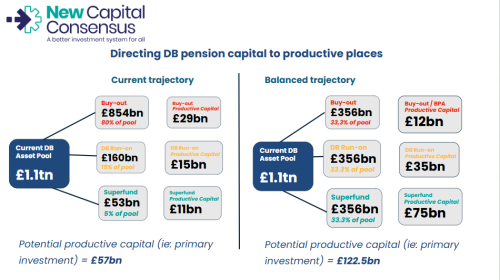
Superfunds have far more freedom to invest that insurers or private DB schemes owned by a commercial sponsor. Yet the playing field is currently tilted towards buyout. Levelling the playing field between Superfunds, run-on and insurance buyout could deliver UK productive investment of £122bn. Tilting it even more and sponsoring 10-15 DB Superfunds, each able to deploy £30-50bn, has the potential to produce significantly more. We need to sponsor investment vehicles able to invest in long-term, illiquid assets to achieve the 'growth in every postcode' that the government is looking for.
What's more, the government could build on the £11bn infrastructure investment undertaken by insurers in 2025 by allowing them to become UK-champions and operate Superfunds as pension funds outside of their Solvency UK ring-fence, using the same approach applied to retail banks,. This would allow them to invest in assets that really move the dial on growth.
There are other important elements the government still needs to grasp. Building regional channels linking pension funds and devolved authorities, reducing overseas flows using tax incentives/disincentives, and revisiting how we measure risk and liquidity to stop accounting and regulatory measures 'shredding' long-term, patient capital into thousands of short-term risks.
But there was an encouraging urgency about the Pensions Minister as he spoke across a number of panels at the Conference. I believe that the government gets the opportunity set here - at the moment, they're just missing a key piece of the jigsaw.

Ashok Gupta
Director of New Capital Consensus
News & Insights
-
Allianz publishes a new report "Pension Reform Survey 2026", reporting "everyone knows reform is needed, few expect it to happen." You can read more here.
-
Stephenson Harwood publishes a defined contribution pension overview series on value for money. You can read more here.
-
LGPS Central publishes a report on some of the challenges facing long-term pension investment in housing can be overcome and demonstrates how pension capital invested in housing can meet the investment objectives and fiduciary responsibilities of local government pension funds. Read more here.
NCC Policy Corner
Our Value for Money Consultation Submission
This month, NCC submitted our response to the DWP's consultation on the proposed Value for Money framework. Whilst we welcome the recognition that current DC pension outcomes are poor and the ambition to bring together regulators under a single framework, we also believe that the current interpretation has too narrow a view of 'what good looks like' for members and the economy.
A snippet of our response below:
The quality of asset allocation in the UK investment system is essential to its function. The current low quality of asset allocation within the UK investment system is central to the lack of investment capital both generating better outcomes for savers and improving the areas they will retire in. Too often, due to structural constraints, schemes are focused on cost-reduction and risk-stripping which herds capital into areas that are unproductive for the UK economy and fail to produce optimal returns over the long-term for members.
NCC believes that VFM will act as a powerful driver of behaviour throughout the system, incentivising how asset allocation processes are developed and implemented. The risk of getting it wrong is high, and the damage that can be caused through getting it wrong has the potential to be substantial and long lasting. An example of this was the cost cap, which inadvertently and unexpectedly incentivised passive investment and exacerbated the flow of investment away from the UK.
Implemented properly, VFM has the potential to generate significantly better outcomes for members and sponsors. Given long-term investment is inherently based upon judgements, NCC's preferred approach to implementing VFM is to adopt a low-risk approach, by implementing forward-looking measures that have the potential to be monitored and fine-tuned in the light of emerging behaviours. This way they can act as a lever for government and regulators and also be used to generate a system feedback loop, which can be used to cultivate the desired behaviours. This approach is particularly required in a rapidly changing, complex, interconnected environment.
Implemented in this way, the Value for Money framework presents an opportunity to incentivise investment behaviours that match members' long-term investment horizons and prevent herding into low-cost, low-return assets. However, critical issues remain unaddressed within the existing proposals. One-dimensional service quality metrics focus on costs and past performance rather than governance quality. The absence of a central data architecture which measures three-dimensional effectivity for members and wider society could create regulatory herding into conservative pools and metrics that schemes can easily game.
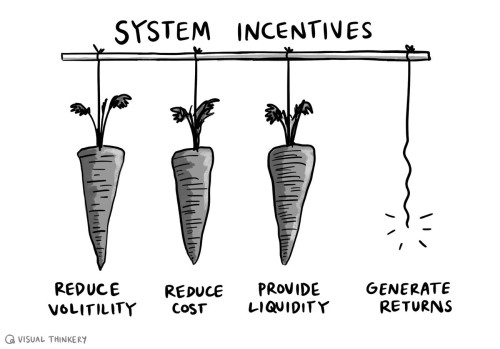
The convergent danger then, is that VFM becomes a compliance checkbox rather than a genuine accountability mechanism as trustees report metrics with little predictive value, regulators lack data to detect problems, and members receive "VFM certificates" that mean nothing.
New Capital Consensus suggests interrogating capital allocation strategies across five critical dimensions - we call this our Effectivity Screen:
Risk Perspective: Do your risk assumptions match your members' actual long-term investment horizons, or are you confusing short-term volatility with genuine investment risk?
Risk Metrics: Does your measurement system accommodate long-term investment, or does it force unnecessary short-term trading behaviour?
Domestic Allocation: How much capital is invested in UK markets versus overseas, and has this been optimised for member outcomes and UK economic productivity, or is it passive adherence to global indices?
Primary Allocation: What proportion of capital flows into primary investment (new issuance, infrastructure, innovation) versus secondary market trading of existing securities?
Risk-Bearing Capital: How much is allocated to genuine risk-bearing capital that matches member time horizons versus defensive assets that provide false comfort?
You can read our full response HERE.
Latest Events

New Capital Consensus are delighted to follow up on an excellent turnout for our webinar on how the UK can rebalance its US-dominated institutional capital flows. The session delved into the systemic factors that drive UK pension funds overseas and the effect this has on the domestic investment system and outcomes for members.
A huge thank you to Alan Livsey (Pensions Editor, Financial Times), Simon Ellis (Chair of a major DC Master Trust) and Ashok Gupta (Director, New Capital Consensus) for their expert leadership of the session.
For those who couldn't make it, you can watch a recording of the session HERE.
Keep an eye on your inboxes for more information on our next session.
NCC in the News

- Altmann tables amendment to allow life insurers to operate DB superfunds. Amendment 92 in the new FSMA Bill reflects NCC thinking. The amendment explores the expansion of DB superfunds. Read more.
-
Bobby Dean MP on why index construction is setting UK pension policy. Member of our Investment Systems Council Bobby Dean MP's Westminster Hall Debate on financial services. Read more.
-
NCC's newest report on risk covered in POLITICO. Greater pension risk pooling could boost productive investment and saver return. Read more.
-
PensionsAge covers NCC Consultation Response. Callum Conway-Shaw writes up our response to the DWP's consultation. Read more.


Please login or register to leave a comment on this post.