
Blogs
NCC Newsletter August '26 - Looking for the Goldilocks Point
From the Director
As we begin to get-to-grips with the new UK administration and its approach to the investment system, a couple of examples of early intent show positive signs.
The shrewd appointment of Lord David Pitt-Watson to the Treasury team is a very welcome one. In addition, the language being used by the new Prime Minister, the new Business Innovation Science and Trade Secretary, Johnny Reynolds, and the happily-still-in-post Pensions Minister, Torsten Bell, on the new UK Scale-Up Fund largely captures exactly what we've been highlighting is a key disconnect in the current system design.
UK institutional capital is not finding the innovative UK businesses that need it most. The connection between savers and society is broken.
"[The new scheme will]…help unlock good growth in every postcode, connecting pension investment with the entrepreneurs and technologies that will reindustrialise Britain and create the jobs of the future”.
“By bringing together major pension investors, the UK Scale-up Fund would help connect institutional capital with the companies, founders and venture managers driving the next wave of British innovation," said new PM Andy Burnham.
The diagnosis is 100% correct and we would be remiss not to view the scheme as a positive step - but it still doesn’t address the disease that is destroying UK investment.
Unless the new Treasury, DWP and Business teams come together to address the structural forces that combine to send our pensions capital overseas to US firms, to sit in low-cost/low-return pools, and undermine the deployment of patient capital, a £1bn fund will be akin to using a pipette to put out a fire.
That we need funds of "sufficient scale to target the best opportunities born out of UK innovation in science and technology" is absolutely right. But what we also need to do is to rebuild the investment architecture to allow what we call 'Goldilocks' funds to thrive. Pools of capital that are of sufficient scale to move the dial on growth, but not so large they have no interest in investing in projects in Barnsley or Basingstoke.
One of the solutions we have suggested, rooted in the 'Manchesterism' of the Local Government Pension Scheme in the PM's backyard, is to allow the creation of our own version of the 'Maple 8' - the Canadian public pension funds (more on that later).
By encouraging the use of the Superfund model which allows the consolidation of DB pensions to the 'Goldilocks point' of approx. £50-80bn and allowing UK-champion life insurers to set them up outside of their current regulatory ringfences, the DWP and Treasury could create a set of funds ready to invest at speed and at scale in the things that will benefit the country that savers will retire in.
And usefully for Andy, within a three year time threshold.

Ashok Gupta
Director of New Capital Consensus
The Policy Landscape: News and Thinking
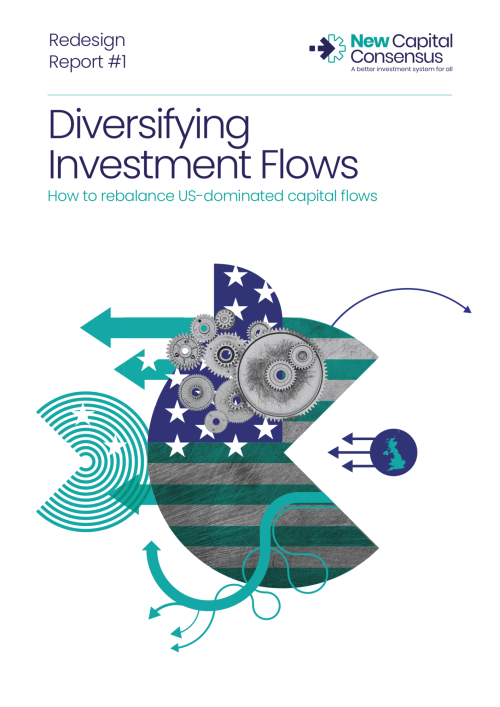
Diversifying Investment Flows: How to rebalance US-dominated capital flows
Launched at the end of July, NCC's newest report is the first of three 'redesign reports' that have been synthesised from a series of cross-sectoral workshops. These workshops gathered voices from the industry with the aim of building consensus around the actions required to redesign our investment system, improve retirement outcomes and boost anaemic growth in the UK.
Each workshop has focused on a particular issue that prevents the system working for both savers and society. From the decline of primary investment, risk transfer from institutions to individuals, and this report - the overseas flow of UK pension capital, primarily towards US tech stocks.
The current mechanics of the system align to send more UK pensioners' money, if invested in the MSCI World Index, to Apple Inc (5.5%) than the entire UK economy combined (3.8%) on any given day. This starves the country that savers will likely retire in of long-term investment capital and essentially hands UK pension policy to those who construct global indexes. In addition, it enables US tech firms to buy up our own fledgling tech businesses at a cheaper price; depriving the country of innovative firms and the growth that comes with them.
The 'Diversifying Investment Flows' report identifies six reinforcing elements of the system that direct our pensions capital overseas and recommends a series of policy proposals to remedy them in concert.
These include:
-
Using an exit tax, combined with a dividend tax relief, to counteract the pull of passive global indexes like the MSCI World.
-
Changing the way we apply 'default' status to funds which automatically invest pensioners money.
-
Addressing benchmark construction and understanding what represents good fundamentals vs weight of money - especially in the wake of the SpaceX IPO.
NCC's Policy Team outlines our stance on the upcoming surplus extraction consultation

The DWP is currently consulting on draft regulations to allow defined benefit (DB) pension trustees to release surplus funds to sponsoring employers. The consultation runs until September 2, 2026, with final legislation expected in April 2027.
NCC broadly supports the fundamentals of the policy proposal. It's helpful to provide alternative opportunities for closed DB endgames other than the largely default insurance buyout approach, which has enjoyed something of a monopoly.
Running on a large, closed scheme within the Pensions legal framework is likely to incentivise much more productive investment approaches than are available under the constraints of Solvency UK after an insurance buyout. This could provide tangible benefits for sponsoring employers, members and the wider economy.
However, NCC is disappointed that this consultation looks at the surplus extraction regime as though it operated in a bubble and takes no account of the wider DB endgame environment the Government is seeking to create. This is a significant omission. It undermines the potential effectiveness of the Government’s own strategy, by focussing on the tactics for a single measure - rather than incorporating other factors which affect DB endgame choices for trustees.
Surplus extraction is set at low dependency. Superfund profit extraction is set at a significantly higher threshold. This is the wrong way round. Superfunds are inherently more secure than sponsor-supported schemes: the uncertain sponsor covenant is replaced by a known capital buffer provided by investors, and TPR’s interim regime imposes rigorous capital adequacy requirements on top. A Superfund must additionally satisfy trustees that it offers a better prospect of paying benefits in full than the exporting scheme. None of this asymmetry is justified by policy rationale.
Left as drafted, it will skew trustee choice away from the very consolidation vehicle — Superfunds — that offers the best prospect of building large pools of productive investment capital at scale.
The Gateway also becomes incoherent. The Superfund Gateway is designed to prevent entry at buyout-level funding. Under the draft regulations as they stand, a scheme could fail the Gateway test, extract surplus down to low dependency, and thereby re-enter Gateway eligibility. That makes a nonsense of the Gateway. NCC’s line is to remove the Gateway, and align the thresholds instead. A coherent threshold regime does the member-protection work the Gateway was meant to do, without the perverse extraction-then-re-entry route the current drafting opens up.
In order to effectively integrate the Surplus Flexibilities measures into a meaningful strategic context, they must be considered alongside and in the context of the other endgame strategies available. Surplus extraction is a strategic lever which needs to be constructed in concert with other elements of the DB endgame process, like the gateway.
These levers must ensure a level playing field for the 'beyond buyout' outcomes between running on, insurance buy-out, and the Surplus Flexibilities sister measure in the Pension Schemes Act 2026 – DB Superfunds.
You can also watch/listen to our podcast episode "Superfunds: Why isn't Consolidation the Endgame?" here.
£6.1 trillion UK investment capital
NCC's Lead Researcher Dr Sania Wadud's latest research shows that the size of the investment capital available in the UK savings and pensions ecosystem now sits at £6.1tn. Her findings indicate that the UK's investable assets grew by £457bn since last year.
You can read the full report here.
Radix Big Tent Summer Fellows Celebration at the House of Commons
This month the NCC team was delighted to attend our partner Radix Big Tent's Summer Fellows Celebration at the House of Commons with guest of honour Rachel Blake, MP for Cities of London and Westminster.
In his speech our Director Ashok Gupta explained how redesigning the investment system is the bedrock of the positive change we want to see in the country, from social housing to climate transition. After launch just 15 months ago, NCC has changed the narrative around the investment system, is frequently quoted in the FT and is increasingly well supported by Parliamentarians of all colours.
You can read RBT's summary of the event here.
Reports from Think Tanks and Trade Bodies
-
The Institute for Fiscal Studies has published a report that presents a range of potential reforms to increase minimum pension contribution rates for people saving in workplace pensions. You can read more here.
-
Hargreaves Lansdown have published new research on the revival of smaller UK companies looking at valuations, investor flows and opportunities plus two fund ideas. You can read the piece here.
NCC Policy Corner - Creating our own "Maple 8"

Britain holds roughly £6.1 trillion of long-term savings, yet invests less in its own productive economy than almost any comparable nation. The capital is not missing. What is missing is the institutional pools large enough, with sufficient investment freedom, to take the patient, long-horizon risk that productive investment requires.
Canada built those institutions. The 'Maple 8' — its eight large public pension funds — that pool risk at scale and invest for the long term in infrastructure,,growth and their own economy. They are admired worldwide precisely because
they are larger pools taking a longer-term view on risk.
Britain can build its own. And quickly. The raw material is some £1.2 trillion of mature, well-funded private defined-benefit (DB) pension capital, currently fragmented across thousands of small schemes and drifting, one by one, into insurance buyout — where assets are de-risked into low-cost, low-return fixed income assets where their productive life ends.
Consolidation of these schemes into pension Superfunds presents a unique opportunity to generate a critical mass of capital which is large enough to deploy high-quality investment expertise, bear higher levels of investment risk throughout retirement and move the dial on growth. But not so large that it won’t be interested in £50-£100m projects which would transform regional and left-behind areas of the UK.
We call this the ‘Goldilocks Point’.
Britain has already got some pools like this in its own public sector. The Local Government Pension Scheme is being consolidated into Superfund-like institutions: the Northern LGPS pool now stewards over £60 billion, and the Greater Manchester Pension Fund has for a decade been a pioneer of patient, productive, regional investment — infrastructure, housing and local growth (Northern LGPS).

Consolidating some of the £1.2tn of fragmented DB capital into a handful of large, well-governed UK Superfunds is the single most concrete, fastest-to-deliver answer to the challenge of anaemic growth in the country.
Instead of the option of ‘running-on’ a pension scheme, the uncertain ongoing support of the sponsoring employer is replaced by a substantial capital buffer provided by investors, legally ringfenced, so that it can only be used to protect members.
Investment risk is pooled between members and profits potentially shared. Such risk sharing extends the investment horizons for members CDC and innovative decumulation solutions can be implemented. Being able to better spread risk across trust-based schemes and contract-based insurance will also reduce concentration of risk and help to mitigate disasters like the LDI-crisis.
With the right alterations to the architecture, and the support of the Government to allow UK life insurers to enter the Superfund market, the Government could sponsor and achieve the establishment of 10-12 vehicles that deliver impactful growth and at-scale investment in long-term assets that benefit society and the UK economy before the next election.
NCC in the News

NCC Feature in Politico's Financial Services Pro: NCC's newest report "Diversifying Investment Flows" appeared in Politico's Financial Services Pro newsletter. Read more.
FT Adviser covers new NCC report: The FT Adviser covers NCC's newest report in "Govt must address US-dominated flows from UK pensions". Read more.
Burnham urged to stem flow of UK pension capital into US tech stocks: NCC's 'Diversifying Investment Flows is written up in Professional Pensions. Read more.
Govt urged to stem flow of UK pension capital into US tech stocks: PensionsAge cover the 'Diversifying Investment Flows' report. Read more.
About New Capital Consensus
New Capital Consensus (NCC) is a coalition of independent and apolitical organisations, including Chatham House, Radix Big Tent, FinSTIC (Financial Systems Thinking Innovation Centre), and the Leeds University Business School, exploring how the investment system can be reformed to produce better outcomes for savers and society.




Please login or register to leave a comment on this post.