
Blogs
NCC Newsletter September '26 - Risk-bearing, allocation skills and 'pinching-the-hose'
From the Director
It’s always struck me as strange that in the UK we have separated the pensions industry from the investment industry. If we give our money to people to look after, over a 20-year period, they need to have serious investment skills. Yet in the UK, these skills often sit not merely in a different company, but in a different industry. When we look at countries with high-quality investment systems, the two are combined in the same entity. Yet somehow the UK has evolved differently.
This separation has relevance to the products we provide savers with and how we define value for money (VFM). It’s a mistake to view VFM as technical issue, it’s a strategic lever with huge significance for how incentivisation operates within the entire system.
This month we are launching our 'Redistributing the Risk-Burden' report. Over recent decades, the pensions and life industries have moved from managing investment risk on behalf of savers to fee-based, capital-light business models which leave all the investment risk (if not all the risk) with savers. This is of detriment to savers and the economy, and fails to address the needs of most of the population. We need to rediscover risk-sharing and risk-pooling, and Government backing for vehicles that have both liability management skills and asset management skills is key to this.
This separation also plays into the VFM debate. The DWP has just extended its Value for Money consultation period, and we believe this is both sensible and illustrative of the seriousness with which we need to address our lack of asset allocation skills in the UK.
The pensions industry has gravitated towards cost, and the investment industry gravitates towards returns. NCC believes that the guiding north star of VFM should be generating good investment returns over the appropriate duration and with sensible fee levels. This requires pension funds and life companies to have high-quality investment skills, particularly in asset allocation and investment strategies.
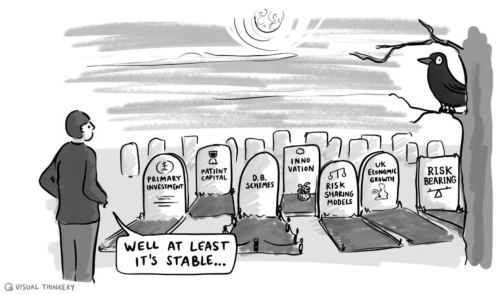
Unfortunately, today too many of our pension schemes are too small to be able to afford such investment skills and too many life insurers outsource investment to too great an extent. Consolidation needs to address this.
Value for money must drive good investment practices. Investment over the long-term is not a mechanical process, it's a judgmental one; for that reason VFM must be forward looking. This is why NCC has proposed a forward-looking Effectivity Screen to compliment any historical looking measures. Value for money cannot just rely on historical rankings. Our recently published report on ‘Diversifying Investment Flows’ highlights the dangers of too great a reliance on benchmarks and describes the systemic risks that can result from this.
These are important debates. We must make sure we have them.

Ashok Gupta
Director of New Capital Consensus
The Policy Landscape
Redistributing the Risk Burden: Collectivising risk for more productive investment
NCC 's latest report is the second in a series of industry-informed research outputs. It follows our report 'Diversifying Investment Flows: How to Rebalance US-Dominated Capital Flows' featured in Politico, FT Adviser, Pensions Age and Professional Pensions (you can read that report here).
'Redistributing the Risk Burden' interrogates how, over the last two decades, the UK has unwound the system in which institutions bore long-term investment risk on behalf of savers. The report is based on a series of cross-industry workshops and finds that a series of self-reinforcing problems have combined to strip products away from savers which allow the collectivisation of risk and over-serve the wealthiest of pension pots.
The knock-on effect of the erosion of risk-pooling over the last 25 years is that the long-term investment capability of institutions has been replaced by short-term, risk-averse and hyper liquidity-focused investment which seeks to protect ‘savings pots’ rather than provide an income for retirement.
The report recommends that supporting innovative investment vehicles that pool risk and spread the potential benefits and downsides of long-term investment could begin to turn the tide on this transfer and enable more ‘appropriate’ risk-bearing through collectivisation. Vehicles like Collective Defined Contribution (CDC) schemes - balancing investment and longevity challenges across all members - should be championed. Similarly, in the DB world, Pension Superfunds which collectivise many small employer-sponsored funds into larger, investor-backed funds with a dedicated capital buffer should be encouraged.
The report also points out the importance of viewing risk-bearing as a valuable activity. It calls on the government, regulators and industry to alter the country’s risk mindset to align with its productive ambitions. Currently, the system currently conflates long-term and short-term risk, pushes investors towards highly liquid, secondary trading, and strands massive capital pools in low-return government debt at the expense of illiquid but higher-value investments that could create growth and provide better returns for savers.
News and Insights
-
Mayer Brown have published an updated government roadmap on upcoming pension reform. You can read more here.
-
The Department for Work and Pensions and the Financial Conduct Authority have extended the deadline of the Value for Money Framework Consultation to 15th September. You can read more here.
NCC Policy Corner - Time is Running Out to 'Pinch the Hose'
This month, NCC's Policy Director, Dan Hedley, dives into the thorny issue of benchmark construction and its knock-on effect on UK pensions policy. With an estimated $17.7bn of passive demand flowing towards SpaceX within days of its Nasdaq listing, how can governments buy time to assess the fallout for index-linked savers' money?

By Dan Hedley, NCC Policy Director
In the Financial Times last month, John Plender asked this question, “...[defined contribution pension fund trustees] need to ask themselves whether their default options incorporate sufficient diversification,” against a Magnificent Seven concentration that his own analysis shows is manufactured by index construction itself, not by trustee choice.
We made the same diagnosis in June when we wrote to the FT (here). Nasdaq’s fast-entry rule and FTSE Russell’s own accommodations pulled SpaceX into major benchmarks within fifteen trading days of listing, conscripting an estimated $17.7bn of passive demand. Some $3.9bn of it came from MSCI World-tracking vehicles - the benchmark underlying most UK DC default funds.
Mr Plender’s article confirms, from an entirely different angle, that this is not a SpaceX peculiarity but the general mechanism: market-cap-weighted index funds are, in his words, "institutionalised momentum trading." Forced buyers of whatever is already largest, regardless of fundamentals, with benchmarking-constrained active managers reinforcing the same distortion for fear of tracking error.
But asking trustees to act is a hospital pass. UK DC trustees have no mechanism to defend their eleven million default-fund members against a benchmark whose construction rules they do not write and cannot alter, on a timetable set by an exchange or index provider, not by them. Diversifying away from a mechanically-inflating index means underperforming it for as long as the inflation continues. This is a career and fiduciary risk that managers structurally cannot take on alone. Trustees do not lack the will. They lack the time, and only government can grant it.
Senator Elizabeth Warren has already made this case on the US side, writing to the SEC and to Nasdaq, FTSE Russell and Morningstar in June demanding they justify accelerated inclusion rules she suspected had been shaped by lobbying from Musk, OpenAI and Anthropic. Her intervention exposed a telling split: those three providers loosened their float tests for SpaceX, while S&P Dow Jones held its twelve-month rule unchanged, which was precisely the two-track outcome Warren’s letters were designed to force into the open. The UK government has made no equivalent effort to interrogate, on British savers’ behalf, why the benchmarks they are defaulted into chose the faster of the two tracks.
The irony is that Whitehall’s own clock is now accelerating in the wrong direction. The Value for Money framework consultation closes on 15 September, with substantive compliance for the largest schemes expected from 2028. DWP and HMRC’s parallel consultations on DB surplus release close on 2 and 7 September, ahead of a new regime from April 2027. Every one of these processes rewards schemes for looking cheap and benchmark-hugging in the short run, and none of them buys trustees room to diversify against concentration risk without being marked down for tracking error in the interim. Regulation, the political cycle and the press all prize what might be called irrational speed over rational haste; none has any institutional interest in granting the pause that rational adjustment requires.
That pause is what government, uniquely, can manufacture. We do not ask for a ban on passive investing, nor for a quota on US equities, both of which would themselves be a crude and costly substitution of one risk for another. We ask for a time-limited moratorium, narrowly targeted at fast-entry index constituents - so that newly and rapidly included constituents are held at zero or a tightly capped weight in default arrangements until they clear ordinary free-float and profitability tests, with TPR guidance and DWP sign-off to give trustees the regulatory cover to act without being penalised. In essence, to ‘pinch-the-hose’ of flow towards these benchmarks.
That is a modest, mechanical fix to a modest, mechanical problem — and it is the only kind of intervention that gives trustees the one thing Mr Plender’s article correctly identifies they need and cannot generate for themselves: time.
Upcoming Events

Diversifying Investment Flows Webinar:
We're delighted to be hosting a webinar on Thursday 10th September, 12noon-1pm on how the UK can rebalance it's US-dominated institutional capital flows - with distinguished Chair Alan Livsey, CFA (Financial Times), panellist Simon Ellis (DC Master Trust Chair) and our own Ashok Gupta (Director, NCC).
This session will delve into the systemic factors that drive UK pension funds overseas and the affect this has on the domestic investment system and outcomes for members. Questions from the audience will also be taken throughout the session.
You can register your interest by emailing francis@newcapitalconsensus.org for more information, or visiting Radix Big Tent's website here.
NCC in the News

- NCC's new report covered in PensionsAge: Greater pension risk pooling could boost productive investment and saver return Read more
- PensionsAge covers NCC Consultation Response: Callum Conway-Shaw writes up our response to the DWP's consultation. Read more
- NCC Responds to the DWP DB Surplus Flexibilities Consultation: NCC's Response to the DWP DB Surplus Flexibilities Consultation - Ensuring DB Endgame Strategic Cohesion. Read more
- NCC Research Director Prof. Iain Clacher in the Corporate Adviser: NCC's Research Director Prof. Iain Clacher publishes "Scale over Mandation" in the Corporate Adviser. Read more
About New Capital Consensus
New Capital Consensus (NCC) is a coalition of independent and apolitical organisations, including Chatham House, Radix Big Tent, FinSTIC (Financial Systems Thinking Innovation Centre), and the Leeds University Business School, exploring how the investment system can be reformed to produce better outcomes for savers and society.




Please login or register to leave a comment on this post.